Dealing with chronic back pain or a recent spinal injury is stressful enough without the added weight of making a major medical decision. If your doctor has recommended surgery or intensive treatment based on your scan, getting a Spine MRI second opinion is one of the most proactive steps you can take for your health.

In many cases, the interpretation of an MRI isn’t just black and white; it requires a high degree of specialization to ensure every detail is captured accurately.

Healthcare CTA

Serious About Your Health? We Are Too.

Partner with India’s fastest-growing diagnostic network for precision
testing.

✓ Advanced Testing Technology
✓ Verified Lab Technicians
✓ Transparent Pricing
✓ Reports in Your Language
Schedule Your Test
Learn More →

What is a Spine MRI Second Opinion?

A spine MRI second opinion is an independent review of your existing spine MRI scan and report by a different, often subspecialized, radiologist. Rather than repeating the expensive and time-consuming MRI scan, a second opinion involves having another expert radiologist carefully examine your original MRI images and provide their professional interpretation.

Why Original Reports Might Be Incomplete or Inaccurate

Spine MRI interpretation is complex and requires specialized expertise. Here’s why discrepancies occur:

Subspecialization Matters:

  • General radiologists may miss subtle findings that spine-specialized radiologists would catch
  • Complex spine conditions require specific training and experience
  • Different radiologists may prioritize different findings
  • Technology and reading techniques vary between facilities

Common Issues with Initial Reports:

  • Under-reporting: Missing subtle disc herniations, nerve compressions, or early degenerative changes
  • Over-reporting: Identifying “abnormalities” that are actually age-appropriate changes
  • Misinterpretation: Confusing normal anatomical variants with pathology
  • Incomplete correlation: Not correlating imaging findings with clinical symptoms

According to a landmark study published in the Spine Journal, approximately 25-30% of spine MRI interpretations show significant changes when reviewed by a fellowship-trained musculoskeletal radiologist. These changes often lead to completely different treatment recommendations.

Healthcare CTA

Serious About Your Health? We Are Too.

Partner with India’s fastest-growing diagnostic network for precision
testing.

✓ Advanced Testing Technology
✓ Verified Lab Technicians
✓ Transparent Pricing
✓ Reports in Your Language
Schedule Your Test
Learn More →

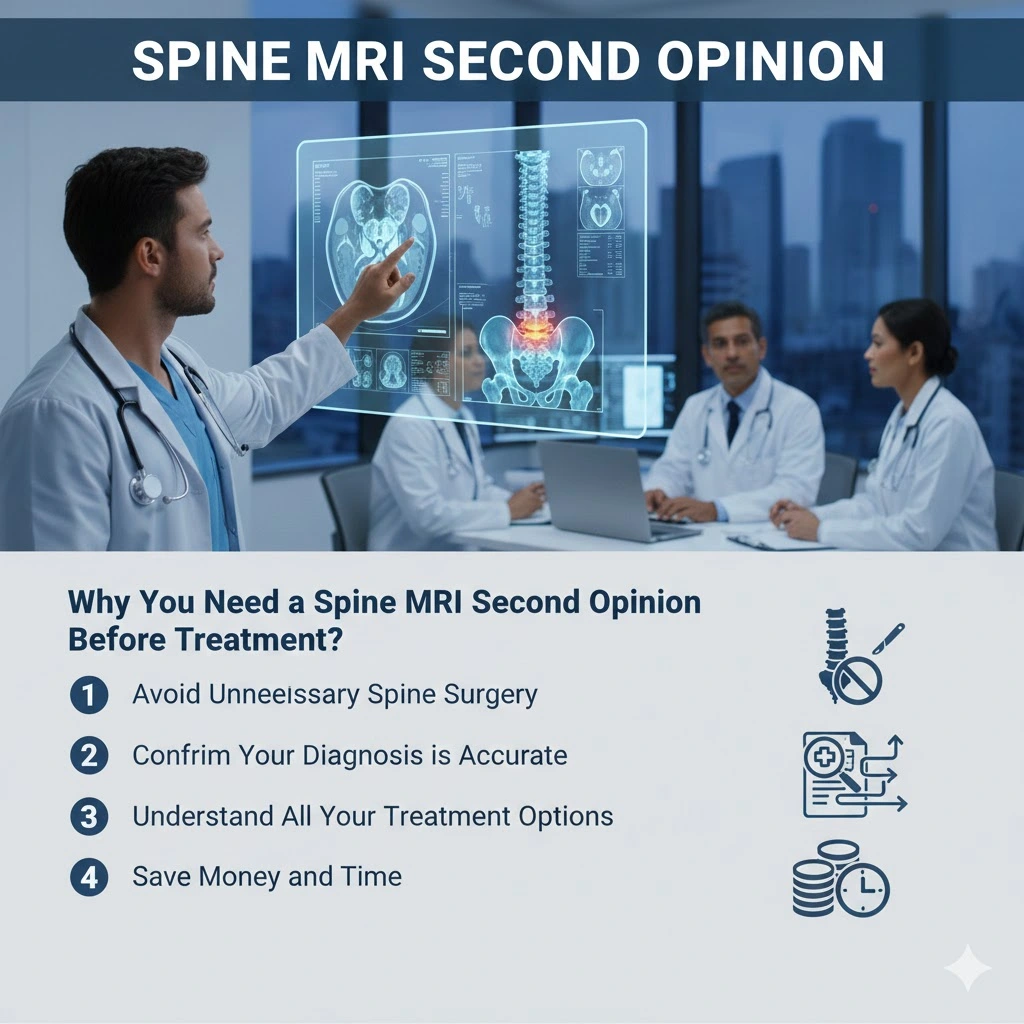
Why You Need a Spine MRI Second Opinion Before Treatment?

Why You Need a Spine MRI Second Opinion Before Treatment

1. Avoid Unnecessary Spine Surgery

Back MRI second opinion reviews have prevented countless unnecessary surgeries. Consider these statistics:

  • 40-50% of recommended spine surgeries may be avoidable with proper diagnosis
  • Spine surgery has a 50-70% success rate (meaning 30-50% don’t achieve expected outcomes)
  • Failed back surgery syndrome affects 10-40% of patients
  • Conservative treatments work for 60-80% of back pain cases

Real-World Example: A 45-year-old patient was recommended for lumbar fusion surgery based on their initial MRI report showing “severe disc degeneration at L4-L5.” A spine MRI report second opinion revealed that while degeneration was present, it was age-appropriate and not the source of their symptoms. The actual problem was a treatable facet joint issue. The patient avoided major surgery and recovered with targeted injections and physical therapy.

2. Confirm Your Diagnosis is Accurate

Spine conditions are complex, and symptoms can have multiple sources:

Commonly Misdiagnosed Spine Conditions:

  • Disc herniation vs. bulge: Herniations may require intervention; bulges often don’t
  • Spinal stenosis severity: Mild vs. severe stenosis requires different treatments
  • Nerve root compression: Location and severity affect treatment approach
  • Spondylolisthesis grading: Grade 1-2 may be conservative; Grade 3-4 might need surgery
  • Tumor vs. infection vs. inflammation: Critical distinction for treatment planning

A second opinion for spine MRI ensures you’re being treated for the right condition with the right approach.

3. Understand All Your Treatment Options

Different interpretations lead to different treatment paths:

Conservative Options (Often Overlooked):

  • Physical therapy and targeted exercises
  • Epidural steroid injections
  • Nerve blocks
  • Chiropractic care
  • Pain management programs
  • Lifestyle modifications

Minimally Invasive Options:

  • Radiofrequency ablation
  • Kyphoplasty/vertebroplasty
  • Endoscopic discectomy
  • Interspinous spacers

Surgical Options (When Truly Necessary):

  • Microdiscectomy
  • Laminectomy
  • Spinal fusion
  • Disc replacement

An MRI spine second opinion provides the accurate foundation needed to explore all appropriate treatment options with your physician.

4. Save Money and Time

While it might seem counterintuitive, getting a spine MRI second opinion can save you significant money:

Financial Considerations:

  • Average spine surgery cost: $50,000-$150,000
  • Failed surgery requiring revision: Additional $75,000-$200,000
  • Second opinion cost: $200-$500 (sometimes covered by insurance)
  • Conservative treatment costs: $2,000-$10,000 annually

Time Considerations:

  • Spine surgery recovery: 3-12 months
  • Return to work after surgery: 6 weeks to 6 months
  • Failed surgery recovery complications: Additional 6-12 months
  • Second opinion turnaround: 3-7 business days

Healthcare CTA

Serious About Your Health? We Are Too.

Partner with India’s fastest-growing diagnostic network for precision
testing.

✓ Advanced Testing Technology
✓ Verified Lab Technicians
✓ Transparent Pricing
✓ Reports in Your Language
Schedule Your Test
Learn More →

When Should You Get a Spine MRI Second Opinion?

Comprehensive Review Process:

  1. Complete Image Analysis Our subspecialized radiologists review every sequence of your MRI:
  • T1-weighted images
  • T2-weighted images
  • STIR (Short TI Inversion Recovery) sequences
  • Sagittal, axial, and coronal views
  • All cervical, thoracic, and lumbar segments as applicable
  1. Detailed Anatomical Assessment We evaluate:
  • Vertebral bodies: Fractures, compression, bone marrow signal
  • Intervertebral discs: Height, hydration, herniations, bulges, extrusions
  • Spinal canal: Diameter, stenosis, encroachment
  • Neural foramina: Size, nerve root compression
  • Facet joints: Arthritis, hypertrophy, cysts
  • Ligaments: Thickening, ossification
  • Spinal cord: Signal abnormalities, compression (cervical/thoracic)
  • Paraspinal soft tissues: Muscles, masses, inflammation
  1. Clinical Correlation We compare imaging findings with:
  • Your symptoms and pain patterns
  • Physical examination findings
  • Previous imaging studies
  • Relevant medical history
  • Current treatment response
  1. Comparison with Prior Studies If available, we compare your current MRI with previous imaging to assess:
  • Disease progression
  • Treatment effectiveness
  • New findings vs. stable findings
  • Acute vs. chronic changes
  1. Comprehensive Written Report You receive a detailed report including:
  • Clear description of all findings
  • Significance of each finding
  • Correlation with symptoms
  • Comparison with original report
  • Recommendations for additional imaging if needed
  • Suggested next steps for discussion with your physician

To make this guide truly comprehensive and useful for your readers, I have broken down the Spine MRI Second Opinion Process into a highly detailed, actionable 5-step framework. This level of detail is excellent for SEO as it answers specific “how-to” questions patients often search for.

Healthcare CTA

Serious About Your Health? We Are Too.

Partner with India’s fastest-growing diagnostic network for precision
testing.

✓ Advanced Testing Technology
✓ Verified Lab Technicians
✓ Transparent Pricing
✓ Reports in Your Language
Schedule Your Test
Learn More →

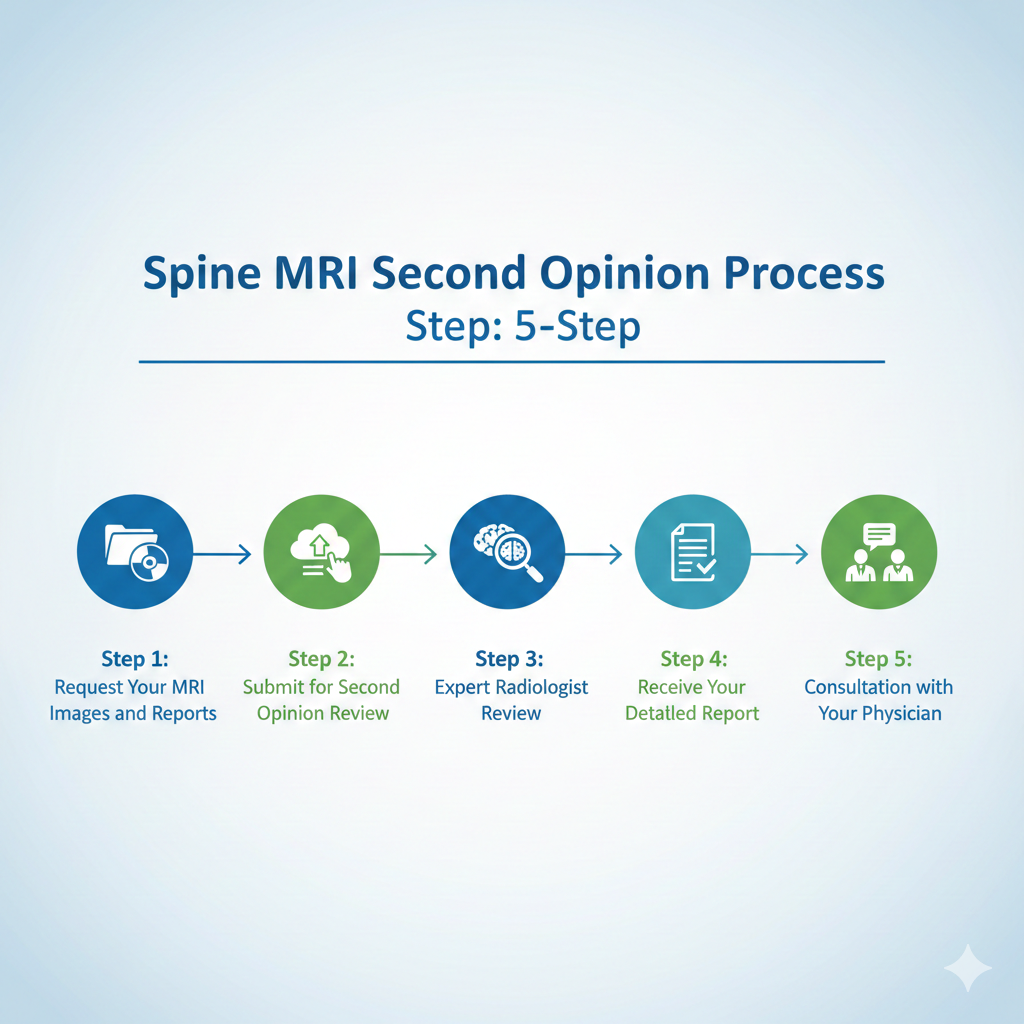
Spine MRI Second Opinion Process: Step-by-Step

Spine MRI Second Opinion Process

Navigating the medical system can be confusing, especially when you are in pain. Getting a second opinion for spine MRI does not have to be a burden. Follow this clear, step-by-step path to ensure you get the most accurate results.

Step 1: Request Your MRI Images and Reports

Your journey begins with gathering your data. Under HIPAA rights, you own your medical records, and the imaging center is legally required to provide them to you.

  • What you need: Ask for the “DICOM” files. These are the high-resolution raw images, not just a PDF or a printed film.
  • How to obtain them: Contact the radiology facility where your scan was performed. Most will provide these on a CD or via a secure digital download link.
  • The Original Report: Ensure you also have the written report from the first radiologist. This allows the second expert to see what was originally identified—and what might have been missed.

Step 2: Submit for Second Opinion Review

Once you have your digital files, you need to choose a specialized service. Seeking Radiology Second Opinions from a dedicated platform is often faster than waiting for an appointment at a university hospital.

  • What to provide: Along with your images, you should provide a brief clinical history. Mention where your pain is located, any numbness or weakness, and how long you’ve been suffering.
  • Submission Methods: Most modern services allow you to “drag and drop” your folders directly into a secure, encrypted web portal.

Step 3: Expert Radiologist Review

This is where the magic happens. Your images are assigned to a sub-specialized neuroradiologist—an expert who has spent their entire career looking specifically at the spine and nervous system.

  • The Review Process: The expert doesn’t just read the first report; they start from scratch. They look at every “slice” of the MRI (axial, sagittal, and coronal views) to identify subtle nerve compressions, disc herniations, or bone spurs.
  • Typical Turnaround: Most professional spine MRI second opinion services provide a completed review within 24 to 48 hours, giving you the answers you need before your next doctor’s appointment.

Step 4: Receive Your Detailed Report

After the review, you will receive a comprehensive spine MRI report second opinion. This report is often much more detailed than the initial one.

  • What’s inside: The report should include a clear breakdown of each spinal level (e.g., L4-L5, C5-C6), an assessment of the spinal cord space, and a “Clinical Correlation” section that explains how the findings match your symptoms.
  • Clarity: A high-quality second opinion uses language that both you and your primary doctor can understand, clearly highlighting “Red Flags” or areas of concern.

Step 5: Consultation with Your Physician

The final, and most important, step is using this information to improve your care. A back MRI second opinion is a powerful tool in your hands.

  • How to use it: Bring the printed second opinion report to your surgeon or primary care doctor.
  • The Conversation: Say, “I had my images reviewed by a spine specialist, and they noted a possible nerve impingement at L5 that wasn’t in the first report. Can we look at that together?”
  • Informed Decisions: This collaborative approach ensures that your treatment plan is based on the most accurate data possible, whether that leads to a new physical therapy routine or a more targeted, successful surgery.

Pro Tip: If you are unsure about how to upload your files, many MRI Second Opinions services offer technical support to help you get your images from the CD to the radiologist’s desk.

Healthcare CTA

Serious About Your Health? We Are Too.

Partner with India’s fastest-growing diagnostic network for precision
testing.

✓ Advanced Testing Technology
✓ Verified Lab Technicians
✓ Transparent Pricing
✓ Reports in Your Language
Schedule Your Test
Learn More →

How to Choose a Quality Spine MRI Second Opinion Service?

To ensure you are getting a truly expert second opinion for spine MRI, look for these specific credentials and service features:

  • Board Certification: At a minimum, the radiologist must be board-certified by the American Board of Radiology (ABR) or an equivalent international body. This ensures they have met the highest standards of medical education and practice.
  • Fellowship Training (Subspecialization): This is the most important factor. You don’t want a generalist; you want a Neuroradiologist or a Musculoskeletal (MSK) Radiologist. These specialists have completed an extra 1–2 years of intensive training focusing solely on the spine, brain, and nerves.
  • Experience Level: Ask how many spine cases the group handles. A service that reviews thousands of spine MRIs annually is more likely to spot rare conditions or subtle “micro-herniations” that a general hospital might miss.
  • Technology and Security: The platform must be HIPAA-compliant. Your medical data is sensitive; ensuring the service uses end-to-end encryption for image uploads is non-negotiable.
  • Communication & Accessibility: Can you ask follow-up questions? A quality spine MRI report second opinion shouldn’t just be a static PDF. The best services offer a way to clarify findings with the radiologist if the report is confusing.
  • Turnaround Time: In the world of spine pain, time is of the essence. Look for services that guarantee a report within 24 to 48 hours. Avoid services that take weeks, as your condition could change in that time.

Healthcare CTA

Serious About Your Health? We Are Too.

Partner with India’s fastest-growing diagnostic network for precision
testing.

✓ Advanced Testing Technology
✓ Verified Lab Technicians
✓ Transparent Pricing
✓ Reports in Your Language
Schedule Your Test
Learn More →

Frequently Asked Questions (FAQs)

How long does it take to get a spine MRI second opinion?

Most spine MRI second opinion services provide reports within 3-5 business days for standard cases. Rush services typically offer 24-48 hour turnaround for urgent situations requiring expedited review. Complex cases with multiple levels, prior surgeries, or unusual findings may take 5-7 business days to ensure thorough analysis.

Do I need to get another MRI scan for a second opinion?

No! A second opinion for spine MRI uses your existing images. You simply need to obtain copies of your MRI CD/DVD and original report from the facility where your scan was performed. This saves you time, money (typically $1,500-$3,000 for a repeat scan), and unnecessary radiation exposure. The subspecialized radiologist reviews your original images using advanced workstations.

Will my insurance cover a spine MRI second opinion?

Many insurance plans cover second opinions, especially before major procedures like surgery. Medicare typically covers 80% of second opinion costs after your deductible. Private insurance coverage varies (50-100%), with some requiring pre-authorization. Contact your insurance company to verify your “second opinion” benefit. Even if not covered, the out-of-pocket cost ($200-$500) is minimal compared to potential savings from avoiding unnecessary treatments.

What if the second opinion differs from my original report?

Discrepancies in 25-30% of cases are actually normal. If your spine MRI report second opinion differs significantly from the original, discuss both reports with your treating physician. Consider:

  • The qualifications of each radiologist
  • Which interpretation better explains your symptoms
  • Whether a third opinion might help
  • Consulting a spine specialist (neurosurgeon or orthopedic surgeon)

Your physician should integrate the second opinion findings into your treatment plan.

Can a second opinion help me avoid back surgery?

Yes! Studies show that 40-50% of recommended spine surgeries may be avoidable with accurate diagnosis and appropriate conservative treatment. A back MRI second opinion may reveal:

  • Your condition doesn’t require surgery
  • Surgery is being recommended at the wrong level
  • Conservative treatments are more appropriate
  • Timing isn’t right for surgery

However, some conditions do require surgical intervention. The goal is ensuring surgery is only performed when truly necessary.

How accurate are spine MRI interpretations?

Accuracy varies based on radiologist expertise. General radiologists interpreting spine MRIs have good accuracy for obvious findings but may miss subtle abnormalities. Fellowship-trained musculoskeletal or neuroradiologists specializing in spine imaging have significantly higher accuracy (95-98%) due to:

  • Years of focused training
  • High-volume experience (1,000+ spine MRIs annually)
  • Expertise in complex spine pathology
  • Understanding of clinical correlations

This is why subspecialized MRI spine second opinions provide added value.

Can I get a spine MRI second opinion online?

Yes! Many reputable services offer secure online spine MRI second opinions. This is often more convenient than in-person consultations. Ensure the service:

  • Uses board-certified, fellowship-trained radiologists
  • Has secure HIPAA-compliant data transmission
  • Provides detailed written reports
  • Offers customer support
  • Has verifiable credentials and reviews

Online second opinions are just as accurate as in-person reviews since radiologists interpret images on digital workstations regardless of format.