


Receiving your MRI results can be an overwhelming experience. You’ve just undergone a complex imaging procedure, and now you’re holding a report filled with medical terminology, anatomical descriptions, and findings that might determine your treatment path. If you’re experiencing MRI report confusion, you’re not alone—and seeking clarity through a second opinion might be one of the smartest decisions you can make for your health.
Why Is There So Much MRI Report Confusion?
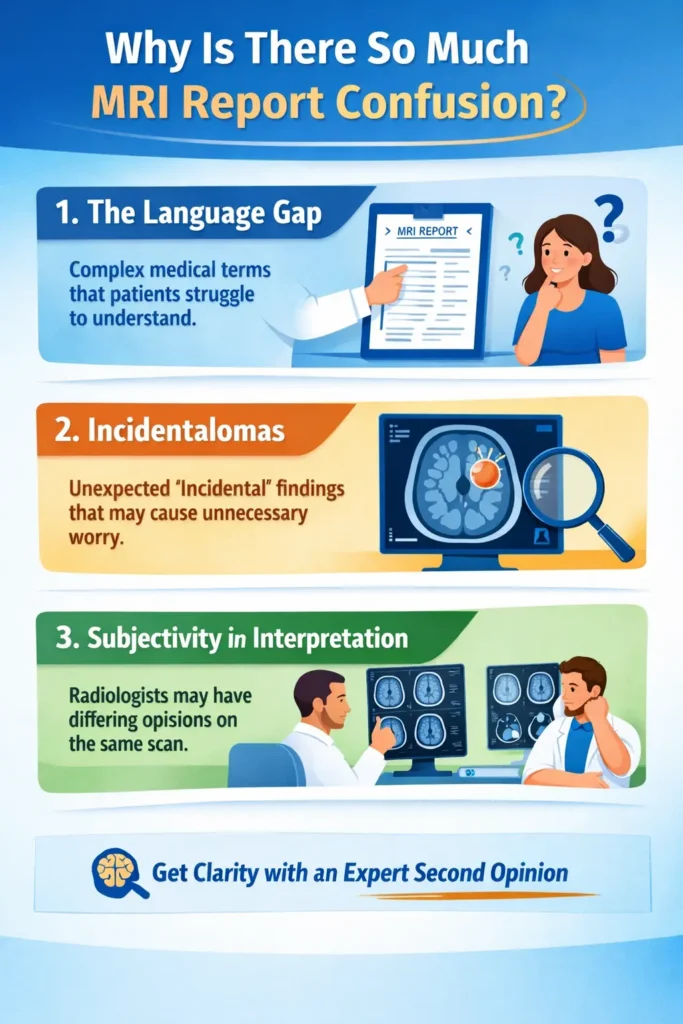
An MRI (Magnetic Resonance Imaging) is an incredibly sophisticated tool. It uses powerful magnets and radio waves to create detailed images of organs and tissues. However, the report generated by the radiologist isn’t written for the patient; it’s a technical communication between specialists.
1. The Language Gap
Radiologists use specific clinical terminology to describe findings with absolute precision. For example, a “herniated disc” might sound catastrophic to a patient, but to a radiologist, it may be a common finding that isn’t actually causing the patient’s pain. Without the context of clinical experience, these terms cause unnecessary panic.
2. Incidentalomas
Modern MRI machines are so sensitive that they often pick up “incidental findings”—minor abnormalities that have no impact on your health but must be documented for legal and medical accuracy. Distinguishing between a “finding” and a “problem” is a major source of MRI report confusion.
3. Subjectivity in Interpretation
Contrary to popular belief, reading an MRI is not an exact science. It is an interpretive art. Two different radiologists may look at the same set of images and come to slightly different conclusions based on their sub-specialty, experience level, and the quality of the equipment used.
Understanding MRI Report Confusion
MRI report confusion is remarkably common among patients. Unlike a simple blood test with straightforward numbers, MRI reports contain detailed radiological descriptions that even healthcare professionals from different specialties might interpret differently. These reports often include:
- Complex anatomical terminology
- Measurements in millimeters
- Descriptions of tissue signal intensities
- Comparisons to previous imaging studies
- Radiologist’s impressions and differential diagnoses
The technical language used in these reports, while necessary for medical accuracy, can leave patients feeling uncertain about what their results actually mean for their health and treatment options.

Serious About Your Health? We Are Too.
Partner with India's fastest-growing diagnostic network for precision testing.
Why MRI Reports Can Be Open to Interpretation
One crucial fact that many patients don’t realize is that radiology, like many areas of medicine, involves a degree of interpretation. Two experienced radiologists might read the same MRI scan and arrive at slightly different conclusions. This isn’t necessarily about right or wrong—it’s about the nuanced nature of medical imaging.
Several factors contribute to variations in MRI interpretations:
Radiologist Specialization: A neuroradiologist specializing in brain and spine imaging might catch subtle abnormalities that a general radiologist could miss. Similarly, a musculoskeletal radiologist has specialized training in identifying orthopedic conditions.
Image Quality: Technical factors during the scan, patient movement, or equipment limitations can affect image clarity, leading to different interpretations.
Clinical Context: Radiologists work best when they have complete clinical information about your symptoms, medical history, and what your doctor is specifically looking for.
Subtle Findings: Some conditions present with very subtle changes on MRI that require specialized expertise to identify, particularly in early stages.
When Should You Consider an MRI Scan Second Opinion?
While not every MRI requires a second review, certain situations strongly warrant seeking an MRI scan second opinion:
1. Serious or Life-Altering Diagnoses
If your MRI suggests cancer, a tumor, significant structural abnormalities, or conditions requiring surgery, an expert MRI second opinion can provide crucial confirmation before proceeding with aggressive treatments.
2. Unclear or Ambiguous Findings
When reports include phrases like “cannot exclude,” “possible,” or “correlate clinically,” this indicates uncertainty that might benefit from another expert’s perspective through an online MRI report review.
3. Treatment Recommendations Don’t Match Your Symptoms
If the proposed treatment seems disproportionate to how you feel, or if your symptoms don’t align with the MRI findings, seeking a second opinion on MRI report can help clarify the situation.
4. Conflicting Information
When different healthcare providers interpret your results differently, or when findings contradict previous imaging studies, additional expert review becomes essential.
5. Before Major Surgery or Invasive Procedures
Any time surgery is recommended based on MRI findings, getting an MRI report review by specialist in that specific anatomical area can help ensure you’re making the most informed decision.
6. Rare or Complex Conditions
For unusual diagnoses or complex anatomical problems, subspecialist radiologists with extensive experience in that specific area can provide invaluable insights.
The Benefits of Getting a Second Opinion on Your MRI
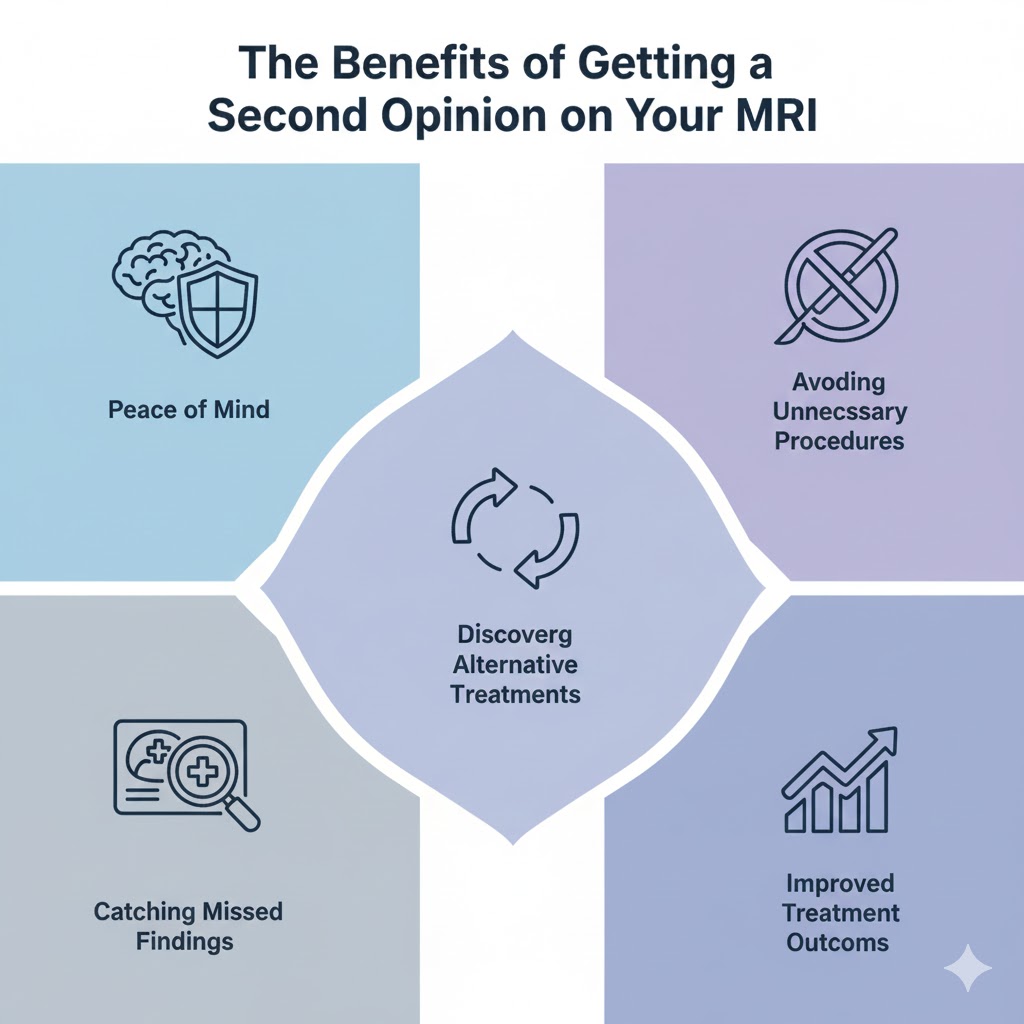
Seeking a second opinion on MRI report offers several important advantages:
Peace of Mind: Confirmation of your diagnosis from multiple experts can reduce anxiety and help you move forward with confidence in your treatment plan.
Avoiding Unnecessary Procedures: Second opinions have been known to prevent unnecessary surgeries or invasive procedures when the initial interpretation was incorrect or overly aggressive.
Discovering Alternative Treatments: A fresh perspective might reveal treatment options you weren’t initially offered, including less invasive alternatives.
Catching Missed Findings: Studies have shown that second opinions can identify findings that were overlooked or underappreciated in the initial reading.
Improved Treatment Outcomes: When you have multiple expert opinions agreeing on your diagnosis and treatment plan, outcomes tend to be better because you’re proceeding with greater certainty.
How to Get an Expert Second Opinion on Your MRI
Thanks to modern technology, obtaining an MRI second opinion has become more accessible than ever. You no longer need to travel long distances or wait months for appointments with specialists.
Online MRI report review services now allow you to:
- Upload your MRI images and reports securely from home
- Have your scans reviewed by subspecialist radiologists
- Receive comprehensive second opinion reports within days
- Access experts who specialize specifically in your condition
- Compare findings and recommendations conveniently
When seeking a second opinion, ensure you provide the actual MRI images (typically on a CD or via secure digital transfer), not just the written report. New radiologists need to review the original images to form their own independent assessment.
Don't Wait for Symptoms - Prevent Them
Early detection saves lives. Book comprehensive health screenings and
online consultations today.
✓ Full Body Checkup Packages
✓ Specialist Doctor Consultations
✓ Results Reviewed by Experts
What to Look For in a Second Opinion Service
Not all second opinion services are created equal. When seeking an MRI report review by specialist, consider:
Board Certification: Ensure the reviewing radiologist is board-certified and has specific expertise in your area of concern.
Subspecialization: Look for radiologists who specialize in the specific body system or condition relevant to your case (spine, brain, joints, etc.).
Comprehensive Reports: The second opinion should include detailed findings, comparison with the original report, and clear recommendations.
Accessibility: The service should make it easy to upload your images and communicate with the reviewing physician if you have questions.
Turnaround Time: While thoroughness is crucial, you also need timely results, especially for urgent medical decisions.
Taking Control of Your Healthcare Journey
Experiencing MRI report confusion doesn’t mean you’re medically illiterate—it means you’re dealing with complex medical information that even healthcare professionals require years of training to interpret. Seeking a second opinion isn’t about doubting your doctor; it’s about being a proactive participant in your healthcare.
Remember that good physicians welcome second opinions because they understand the value of additional expert perspectives, especially for complex cases. Your health is too important to leave any uncertainty unaddressed.
Whether you’re facing a serious diagnosis, planning surgery, or simply feeling uncertain about your results, an expert MRI second opinion can provide the clarity and confidence you need to make the best decisions for your health.
Frequently Asked Questions (FAQs)
Q: Is it okay to ask for a second opinion on my MRI?
A: Absolutely. Seeking a second opinion is a standard and respected practice in medicine, especially for complex imaging studies. Most physicians encourage it for significant findings or major treatment decisions.
Q: Will my doctor be offended if I request a second opinion?
A: Professional physicians understand that second opinions are part of quality healthcare. They shouldn’t be offended—in fact, many doctors recommend second opinions for complex cases themselves.
Q: How much does an MRI second opinion cost?
A: Costs vary depending on the service and whether you use insurance. Online second opinion services typically range from $200-$600, which is often much less than the cost of unnecessary treatments or procedures.
Q: How long does it take to get a second opinion on an MRI?
A: Through online services, you can typically receive a comprehensive second opinion within 24-72 hours. Traditional in-person consultations may take several weeks to schedule.
Q: Do I need my doctor’s permission to get a second opinion?
A: No, you don’t need permission. However, you will need to obtain copies of your MRI images and reports, which you have a legal right to access.
Q: What if the second opinion contradicts the first?
A: Discordant opinions happen in about 10-20% of cases. When this occurs, discuss both interpretations with your treating physician, and consider obtaining a third opinion or additional testing if needed.
Q: Can I get a second opinion if my MRI was done years ago?
A: Yes, though for some conditions, your doctor might recommend a new MRI to see how things have changed over time. However, historical images can still be reviewed for accuracy.
Q: Will insurance cover a second opinion?
A: Many insurance plans do cover second opinions, especially before major surgeries. Check with your insurance provider about their specific policies and coverage requirements.