


Knee pain affects millions of people worldwide, and an MRI scan is often the first step toward diagnosis. But what if your MRI report is unclear, contradictory, or doesn’t align with your symptoms? This is where a knee MRI second opinion becomes crucial.
Studies show that radiological interpretations can vary significantly between readers. In fact, research published in the Journal of the American College of Radiology found that second opinions result in changed diagnoses in 10-20% of cases, with major clinical implications in 5-10% of those cases.
At Ilios Health, we understand that your knee health impacts your mobility, career, and quality of life. Let’s explore why getting a second opinion on your knee MRI might be one of the most important healthcare decisions you make.

Serious About Your Health? We Are Too.
Partner with India's fastest-growing diagnostic network for precision testing.
What is a Knee MRI Second Opinion?
A knee MRI second opinion is when a different radiologist—often one with specialized expertise in musculoskeletal imaging—reviews your existing MRI scans and provides an independent interpretation.
Key Points:
- No new scan needed – Uses your existing MRI images
- Expert review – Board-certified radiologists with subspecialty training
- Comprehensive report – Detailed findings with treatment recommendations
- Online convenience – Get expert opinions without traveling
Unlike getting a completely new MRI (which involves radiation exposure in some cases, additional costs, and time), a second opinion leverages your existing diagnostic images.
When Should You Consider a Knee MRI Second Opinion?
Not every MRI requires a second look, but certain situations strongly warrant expert review.
Common Scenarios:
1. Unclear or Vague Diagnosis
Your MRI report uses ambiguous terms like “cannot exclude,” “possible,” or “findings are nonspecific.” These phrases indicate diagnostic uncertainty.
2. Your Symptoms Don’t Match the Report
You’re experiencing severe knee pain, but the MRI shows minimal abnormalities—or vice versa. This disconnect suggests something might be missed.
3. Surgery Has Been Recommended
Before any surgical intervention (ACL reconstruction, meniscus repair, knee replacement), a second opinion can confirm the necessity and help you explore conservative treatment options.
4. Treatment Hasn’t Improved Your Condition
You’ve undergone treatment based on the initial MRI findings, but your knee pain persists or worsens.
5. Conflicting Opinions from Multiple Doctors
Two orthopedic surgeons have given you different diagnoses or treatment plans based on the same MRI.
6. Complex or Rare Conditions
Conditions like osteochondritis dissecans, stress fractures, or unusual tumor presentations require specialized expertise.
7. Workers’ Compensation or Legal Cases
Accurate documentation is critical for insurance claims, disability determinations, or personal injury cases.
Serious About Your Health? We Are Too.
Partner with India's fastest-growing diagnostic network for precision testing.
Common Knee Conditions Detected on MRI
Understanding what MRI can reveal helps you appreciate the value of expert interpretation.
| Condition | What MRI Shows | Why Second Opinion Matters |
|---|---|---|
| ACL Tear | Discontinuity of ligament fibers | Partial vs. complete tears affect treatment |
| Meniscus Tear | Abnormal signal in cartilage | Degenerative vs. traumatic tears require different approaches |
| Cartilage Damage | Chondral defects, thinning | Grading severity impacts surgical decisions |
| Bone Bruises | Marrow edema patterns | Can indicate ligament injuries not visible otherwise |
| Patellar Tracking Issues | Malalignment, cartilage wear | Conservative treatment may avoid surgery |
| Baker’s Cyst | Fluid collection in popliteal fossa | Determining underlying cause is key |
| Tendinitis/Tendinosis | Signal changes in tendons | Distinguishing inflammation from degeneration |
| Fractures | Bone marrow edema, cortical breaks | Stress fractures easily missed on X-rays |
Why MRI Interpretations Vary: The Science Behind Second Opinions
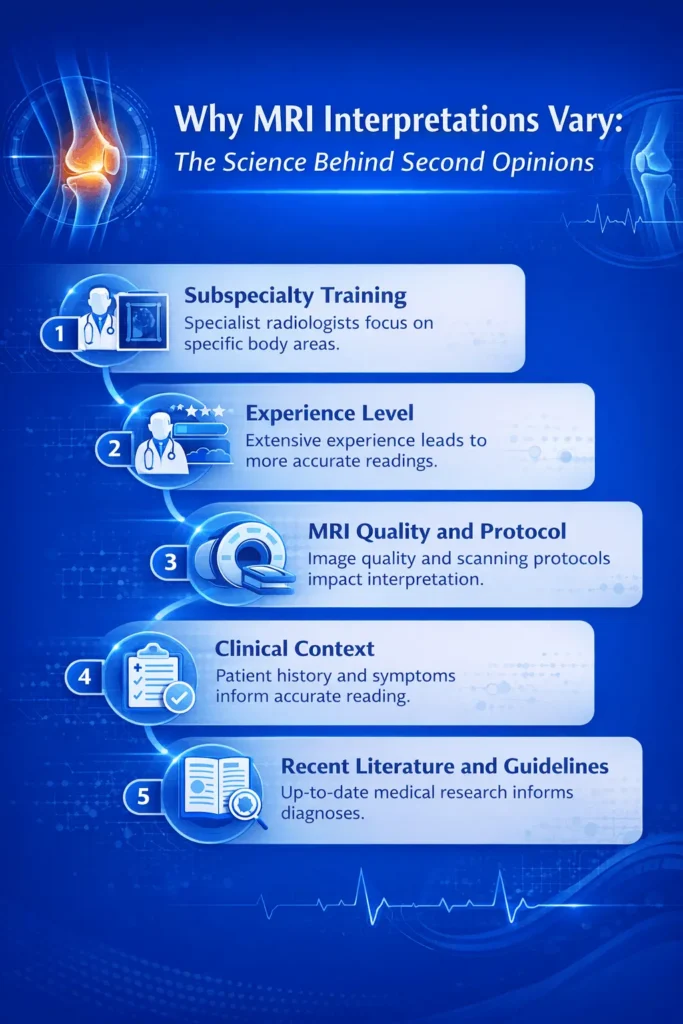
You might wonder: “Why would two radiologists see the same images differently?”
Factors Affecting MRI Interpretation:
1. Subspecialty Training
A general radiologist may review 50+ different body parts daily. A musculoskeletal (MSK) specialist focuses exclusively on joints, bones, and soft tissues, developing pattern recognition that comes from seeing thousands of similar cases.
2. Experience Level
Studies show that radiologists with 10+ years of MSK experience have 15-20% higher diagnostic accuracy for subtle findings compared to general radiologists.
3. MRI Quality and Protocol
Sometimes the original MRI wasn’t optimized for knee imaging. An expert can identify whether imaging sequences were adequate or if repeat imaging with better protocols is needed.
4. Clinical Context
Radiologists perform better when they have complete clinical information. Your age, injury mechanism, and specific symptoms guide interpretation.
5. Recent Literature and Guidelines
Medical knowledge evolves. A specialist stays current with the latest research on conditions like early osteoarthritis detection or cartilage repair outcomes.
Ilios Health Advantage: Expert Knee MRI Second Opinions
At Ilios Health, we’ve built a platform that connects you with top-tier radiologists specializing in musculoskeletal imaging.
Our Process:
Step 1: Upload Your Images
Securely upload your knee MRI scans (usually a CD or digital files from your imaging center).
Step 2: Provide Clinical Details
Share your symptoms, injury history, previous treatments, and specific concerns through our HIPAA-compliant platform.
Step 3: Expert Review
Your scans are reviewed by board-certified radiologists with fellowship training in MSK imaging. Many have 15+ years of specialized experience.
Step 4: Comprehensive Report
Within 24-48 hours, receive a detailed report including:
- Line-by-line comparison with original report
- Clarification of ambiguous findings
- Additional findings (if any)
- Clinical correlation and recommendations
- Images with annotations
Step 5: Consultation (Optional)
Discuss the findings with our radiologists via telemedicine if needed.
Empowering Your Conversation with Your Doctor
A second opinion isn’t meant to replace your primary orthopedic doctor. In fact, most good surgeons welcome a second radiology report.
It provides your doctor with more data. If two experts agree, you can move forward with 100% confidence. If they disagree, it sparks a vital conversation about the best path forward.
Being an “empowered patient” means taking an active role in your healthcare. It means asking questions and ensuring no stone is left unturned.
When you walk into your next appointment with a subspecialist report in hand, you are no longer just a passenger in your treatment—you are the co-pilot.
Why You Should Consider a Radiology Second Opinion
You might wonder, “If I already have a report, why do I need another one?” The answer lies in the level of expertise.
In many hospital settings, a general radiologist reviews your scan. They are trained to look at everything from brain bleeds to broken toes.
However, a musculoskeletal (MSK) radiologist focuses exclusively on bones and joints. They have seen thousands of knee scans and understand the nuance of sports injuries.
By seeking Radiology Second Opinions, you are ensuring that a sub-specialist is the one making the final call on your health.
Serious About Your Health? We Are Too.
Partner with India's fastest-growing diagnostic network for precision testing.
Why Choose Ilios Health?
At Ilios Health, we understand that behind every MRI scan is a person who wants to run, dance, or simply play with their kids again.
Our platform is designed to provide world-class expertise without the wait. Here is how we make it simple:
Easy Uploads: You can securely upload your MRI files (DICOM) directly from your computer.
Elite Network: Your scan is assigned to a board-certified, sub-specialized radiologist.
Fast Turnaround: Most reports are delivered within 24 to 48 hours.
Clarity: We don’t just give you a list of findings; we explain what they mean for your recovery.
Frequently Asked Questions (FAQs)
Q1: How long does it take to get a knee MRI second opinion?
Answer: At Ilios Health, most knee MRI second opinions are completed within 24-48 hours of receiving your images and clinical information. Urgent cases can often be expedited. This is significantly faster than scheduling an appointment with a new specialist, which might take weeks or months.
Q2: Do I need a new MRI scan for a second opinion?
Answer: No. A second opinion uses your existing MRI images. You simply need to obtain a copy of your MRI (usually on a CD or via digital download) from the facility where you had the scan. This saves time, money, and avoids unnecessary repeat radiation exposure. In rare cases, if the original MRI quality is inadequate or missing key sequences, the reviewing radiologist may recommend specific additional imaging.
Q3: Will my insurance cover a knee MRI second opinion?
Answer: Coverage varies by insurance plan. Many insurers cover second opinions, especially when:
- Surgery has been recommended
- There are significant treatment decisions to be made
- It’s part of a workers’ compensation claim
Check with your insurance provider using CPT codes 99271-99275 (consultation codes). Even if not covered, the out-of-pocket cost ($200-$500) is usually far less than unnecessary treatments or procedures.
Q4: What if the second opinion disagrees with my original report?
Answer: Disagreements happen in 10-20% of cases, ranging from minor clarifications to major diagnostic changes. When reports differ:
Step 1: Review both reports carefully with your treating physician
Step 2: Consider the expertise level—subspecialist opinions often carry more weight
Step 3: If there’s a major discrepancy affecting surgery or significant treatment, you might want a third opinion or a “tie-breaker”
Step 4: In some cases, additional imaging or clinical tests can resolve ambiguities
At Ilios Health, our radiologists explain their reasoning clearly and can discuss findings with your referring physician to ensure coordinated care.
Q5: Can a second opinion really prevent unnecessary knee surgery?
Answer: Absolutely. Research shows that 5-15% of orthopedic surgeries might be avoided with accurate diagnosis and consideration of conservative treatments. Common scenarios where second opinions prevent surgery:
- Degenerative meniscus tears in middle-aged patients (often respond to physical therapy)
- Mild-moderate osteoarthritis (where joint preservation strategies haven’t been tried)
- Misdiagnosed conditions (pain from hip or spine referred to knee)
- Overestimated injury severity (partial ligament tears that can heal)
A second opinion provides clarity and confidence—whether that means proceeding with recommended surgery or exploring alternative treatments.